Table of Contents
When I started watching Stargate SG-1, I knew there’d be some wild takes waiting in the early seasons — but starting 'Emancipation' with “Is that a woman?” in the first five minutes? That was strange. And it only got worse from there.
Episode Synopsis
SG-1 visits a planet where women are treated as property, and Captain Carter becomes the target of a local warlord after defying their laws. What begins as a rescue mission turns into a fight for equality — with Carter challenging an entire culture’s idea of honor.
I get that SG-1 was still finding its voice in those early episodes, but this one feels like a huge misstep. Then again, hindsight’s 20/20 — so let’s dive into forty minutes of pure, chaotic energy.
A Good Place to Start is... WTF?
SG-1 lands on a planet where the local culture — which Daniel Jackson claims is loosely based on the Mongols — views women as property.
A woman cannot speak unless spoken to, cannot wear men’s clothes, and if she shows her face in public, she dies.
It’s an understandable setup: a chance to showcase Carter standing her ground as a feminist in a barbaric world. I get the intention.
But why do it like this?
We already saw Carter deal with sexist remarks back in the pilot — her iconic “don’t worry, I played with dolls when I was little” comeback worked because it felt grounded. Here, it just feels forced.
In the words of today’s kids, this episode gave me the ick — but I also get it. It’s a product of its time.
"I'm Not an Anthropologist!"
"Well, you are today!"
O’Neill orders Carter to stay with the women while the men go off to party. She’s dressed for the occasion, and Abu — the chieftain’s son — immediately comments on her beauty.
What really threw me off was seeing both Daniel and O’Neill look at her like they had just witnessed the most angelic being in the universe. She’s pretty, sure — but come on, guys. You’re both married men. You should be beyond that phase.
So, I decided to play anthropologist myself. Turns out, Mongol women were not treated this way at all. They managed households, livestock, and even entire camps while the men were away. Some even advised their khans and handled trade.
In trying to give Carter her big feminist moment, the episode ends up flattening an entire culture to make its point.
Then Abu Kidnaps Carter - Here's Why
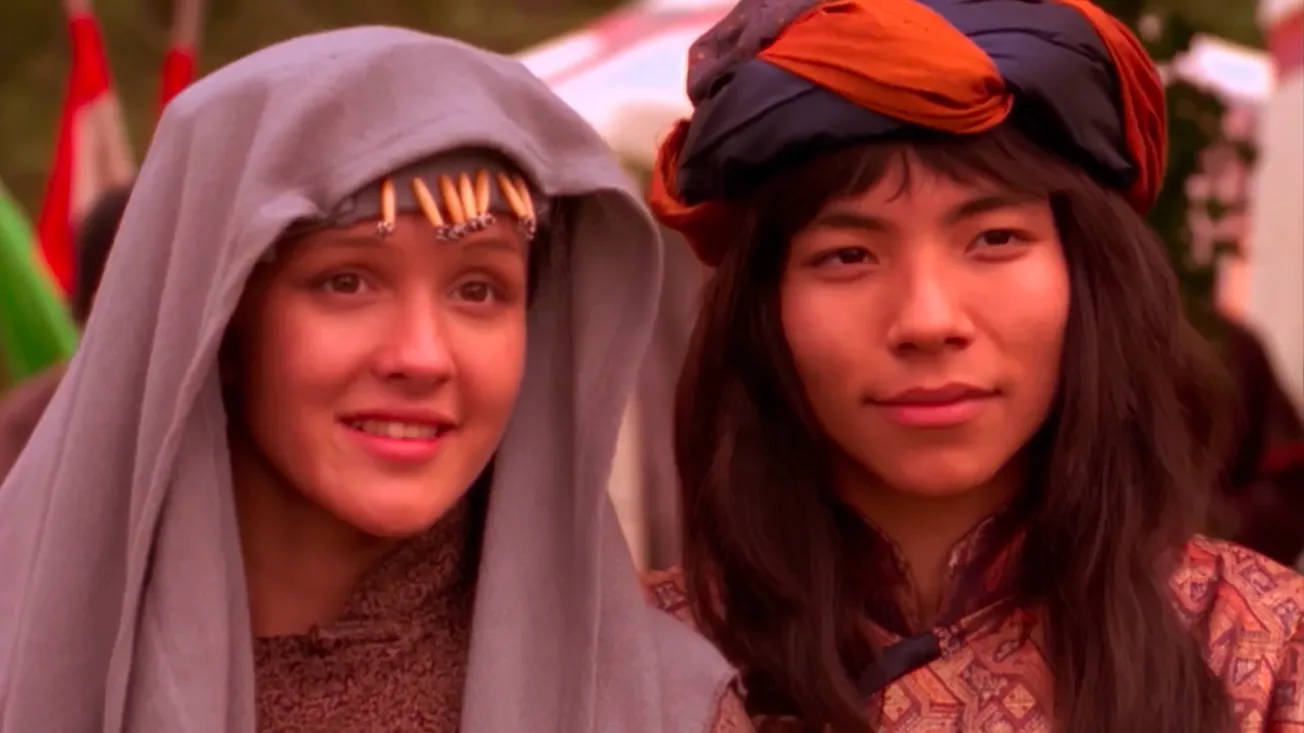
Abu, being a product of his culture, hatches a grand plan: he’ll sell Carter to a rival chieftain in exchange for the woman he loves — Nya, the chieftain’s daughter.
Shockingly, it doesn’t go well. Instead of getting Nya, he’s humiliated and given an ultimatum — take the money or die. So not only did he sell Carter, but he also lost the girl. Poor kid never had a chance.
That’s one lesson that actually does land. In the immortal words of Cersei Lannister: “Power is power.” And Abu had none. He’s young, naïve, and thought he could game a system built to crush people like him.
Meanwhile, Carter meets the new chieftain — and true to form, she doesn’t bow. Her confidence earns her a slap across the face. This guy doesn’t tolerate women speaking unless spoken to, and he’s not shy about violence to prove it.
Guys… this was rough to watch. I know I’m 38 and technically lived through this era of TV, but damn, it hits different in 2025. What once passed for “feminist commentary” now just feels cringe and outdated.
Carter Spends Some Quality Time In The Village
Carter was smart enough to relent — she knew this was a tough situation. She trusted her team to come back for her, so in the meantime, she played along.
Before that, though, she did try to escape on horseback. Nice try, honestly. But she got caught, and because of her failed attempt, the women with her — including Nya’s mother — were sentenced to lashing. Carter steps up and says,
“If you need to hit a woman to help you feel more like a man, try me.”
It’s a good line, but it also feels… forced. We get it, Carter — you’re strong, we’re with you. But a quieter line like “I tried to escape. If you need to punish someone, punish me” might’ve landed harder. Not every beat needs to be a speech.
And what does that moment earn her? A freaking sexual assault on TV. Yup — the chieftain doesn’t hit her. He kisses her. Full-on, without consent. Oh boy.
Later, we get a quieter scene between Nya and Carter, where Nya thanks her for protecting the women. Carter uses the moment to introduce her to the revolutionary concept of “No.” It’s tender, even empowering — the episode’s one genuinely good exchange between women.
Meanwhile, O’Neill and the team are on their way to trade for her, because the implication is clear: if Carter spends the night at this camp, things will get ugly. The chieftain plans to “partake” in his new prize.
When SG-1 finally arrives, Carter sets a fire as a distraction, giving Nya a chance to escape. It’s chaotic, but for the first time in the episode, she’s taking back control on her own terms.
O'Neill Buys Carter Back With a Gun
All that work… so O’Neill can save Carter with a gun?!
It’s the biggest “come on” moment of the episode. If you wanted to empower Carter, have her do something the chieftain can’t ignore — something clever or symbolic. There were so many better options. (Judith and Holofernes comes to mind, but maybe that’s a bit much for 90s sci-fi.)
Having O’Neill barter with a weapon isn’t the win the writers probably thought it was. It undercuts everything the episode seemed to be building toward — Carter’s strength, her autonomy, her growth.
Thankfully, she gets a chance to redeem that arc the next morning when Abu rushes into camp, announcing that Nya will be stoned for running away.
The Stoning We All Saw Coming And Carter's Victory
Ah, we can’t have a story about a medieval culture without a good stoning, can we?
Carter feels responsible for Nya’s fate after helping her escape. So, the episode pulls out the convenient rulebook of old chieftains: another chieftain can intervene to stop a stoning. The rival leader refuses to fight Abu’s aging father, so Carter steps up to fight in his place.
Of course, she crushes it.
But the resolution feels like half-baked writing. The duel was supposed to be to the death, yet Carter simply knocks him down. Suddenly, with one well-placed dagger at his throat, he declares peace between tribes, frees Nya, and admits Carter’s victory.
Convenient much? Yeah, I thought so too.
Carter gets her hero moment, but the win feels a little plastic — more like the show trying to check a “feminist episode” box than delivering real growth.
What a Wild Story This Time! What Did You Think?
This was a wild one to watch. I get that it’s a '90s show, but Emancipation might be the perfect definition of an episode that didn’t age well.
Compare it to something like Nosedive from Black Mirror — that one ages like fine wine and gets scarier every year. Emancipation? Not so much.
What did you think? Were you creeped out like I was? Drop a comment below — I’d love to hear how this one hit you on rewatch.
Read the previous episode review here, or the next one here.