Should You Play Avatar: Frontiers of Pandora?

“Holy shit.”
That was my genuine reaction when Nimun, my Ikran, carried me above the trees and mountains and let me see Pandora from a perspective I’d never experienced before.
I laughed as a perfectly placed arrow turned enemies into fireworks.
I felt my chest tighten when my friend Itu lost Zomey, his Ikran.
And maybe most unexpectedly, I felt something close to grief—and gratitude—watching the land heal in real time as I dismantled RDA bases.
It made me appreciate Earth in a way only fiction can. Because this kind of healing? It’s something our planet doesn’t get.
That said, this game isn’t perfect.
So the real question is: Is Avatar: Frontiers of Pandora worth your time?
Let’s talk about it.
Pandora Is Breathtaking (And That’s Not Hyperbole)
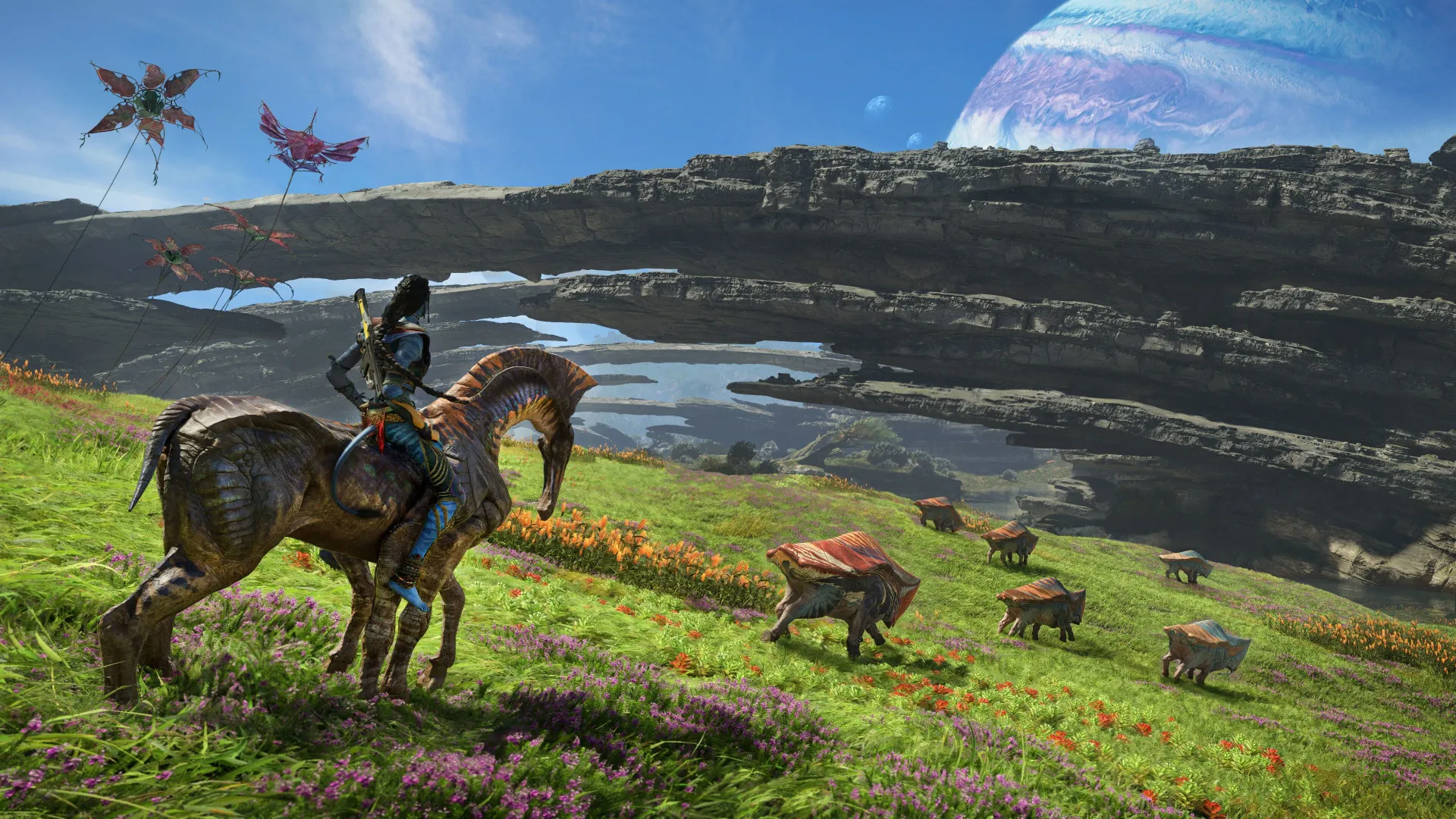
This game brings “nature” to a whole other level. Pandora isn’t just something you move through—it’s something you inhabit.
It looks stunning during the day, but at night it becomes something else entirely. More than once, I caught myself just strolling through the world, not chasing objectives, just existing in it.
What really sells the experience is how alive everything feels. People move, talk, and react to your presence in ways that make the world feel responsive rather than staged. It’s immersive in a quiet, confident way.
That immersion did crack a few times when the game crashed back to Windows. Thankfully, after updating my graphics drivers—and likely a few patches on Ubisoft’s side—that issue disappeared entirely.
Combat Is Satisfying—Even When It’s Rough
One of the hardest RDA bases I ran into early on was a massive outpost marked for level 20. I finished the main game at level 19 and went back for it anyway.
I failed that final boss fight more times than I care to admit. But when I finally cracked it—and watched the entire area turn green—it felt earned.
Combat shines when you learn the rules of the world. Mechs can’t fit into tight spaces. Certain vantage points let you reset, heal, and craft on the fly. Even in the final fight, I had a small hiding spot that became my lifeline.
The rough edge comes from gear progression. Combat effectiveness is directly tied to how much time you’re willing to invest in hunting rare crafting ingredients.
That’s also where the monetization surprisingly worked for me. Buying a bundle of Bladewing Moth wings didn’t feel like cheating—it felt like saving time I already understood how to spend. That’s a trade-off I can respect.
The Northern Frontier Is Beautifully Lonely
I’ve said it before, and I’ll say it again: not having companions is the game’s biggest missed opportunity.
Yes, you meet plenty of characters along the way—but you always return to being alone. And while that loneliness fits the tone of the Northern Frontier, it also leaves emotional potential on the table.
Throughout my playthrough, I kept seeing natural companion candidates: Nor, who disappears entirely at one point; Ri’nela, whose personal arc could have grown into something deeper; Teylan, for obvious story reasons; Itu, who suffers an early tragedy you never really help him process; and Etuwa, a young Tsahik who could have supported you both narratively and emotionally.
A companion system would have required more story work—but mechanically, the rest of the game could have stayed exactly the same. And I think it would have dramatically elevated the experience.
A Game That Truly Understands Avatar
At its core, Avatar is about showing us that our own “Eywa” is worth protecting.
Earth doesn’t heal instantly when you shut down an oil rig. Forests don’t regrow overnight after they burn. But nature does recover—slowly, stubbornly, and despite us.
Frontiers of Pandora understands that. A huge part of the game revolves around dismantling RDA bases and watching the land recover in real time. The air clears. The colors return. The world breathes again.
That’s not accidental. It’s the game quietly teaching values through action.
I remember Avatar: The Game from 2009. It also understood Avatar—but it was released in an era that couldn’t fully support what it was trying to do. Frontiers of Pandora finally feels like the realization of that idea.
A Soundtrack That Knows When to Speak—and When to Stay Silent
Flying with my Ikran above Pandora’s landscapes is something the game actively rewards. More than once, I’d be soaring with Nimun when an epic musical cue would rise seemingly out of nowhere—and it always felt earned.
Imagine flying over Pandora in complete silence. It would feel wrong.
Beyond those moments, the soundtrack adapts beautifully. Ominous tones while infiltrating RDA bases. Warmer, communal music in Na’vi settlements.
No matter the context, the music understands exactly what the moment needs.
Final Verdict: Should You Play It?
Yes, especially if Avatar ever meant something to you.
Avatar: Frontiers of Pandora isn’t flawless. It crashes occasionally, its systems can be rough, and it leaves emotional potential untapped by keeping you alone for most of the journey.
But when it works—and it often does—it delivers moments no other Avatar experience has. Flying above Pandora. Watching the land heal. Feeling like your actions actually matter to the world around you.
This isn’t just a licensed game. It’s a game that understands its source material and uses interactivity to say something meaningful with it.
If you’re even mildly curious about Pandora, this is worth your time.
I’d love to hear what you thought—did Frontiers of Pandora click for you, or did it fall short of what you hoped it would be? Drop your thoughts in the comments.
No spam, no sharing to third party. Only you and me.