Table of Contents
Fragrant popcorn in my arms, I sank into a VIP seat one evening in late December to watch Avatar: Fire and Ash. These films aren’t just movies for me. They’re events.
The first Avatar in 2009 told a complete story. The Way of Water opened the door to something bigger. New characters. New conflicts. New promises. It expanded the world and left threads hanging everywhere.
Fire and Ash had a mission. Close those threads. Deliver payoff. Prove this saga still has momentum.
Did it?
Fire and Ash Commits to Continuity
The Way of Water opened a new chapter in Pandora’s history by introducing Jake’s Na’vi family and their sheltered life before the RDA came back.
When it ended, the immediate conflict was resolved, but the bigger picture wasn’t. The RDA was still on Pandora. Quaritch was still alive. And the Sully family still had to live with the grief of Neteyam’s premature death.
That’s a lot to carry into a sequel.
Fire and Ash had to move the story forward while honoring everything that came before it. And in my opinion, the new plots weave surprisingly well into those existing threads instead of distracting from them.
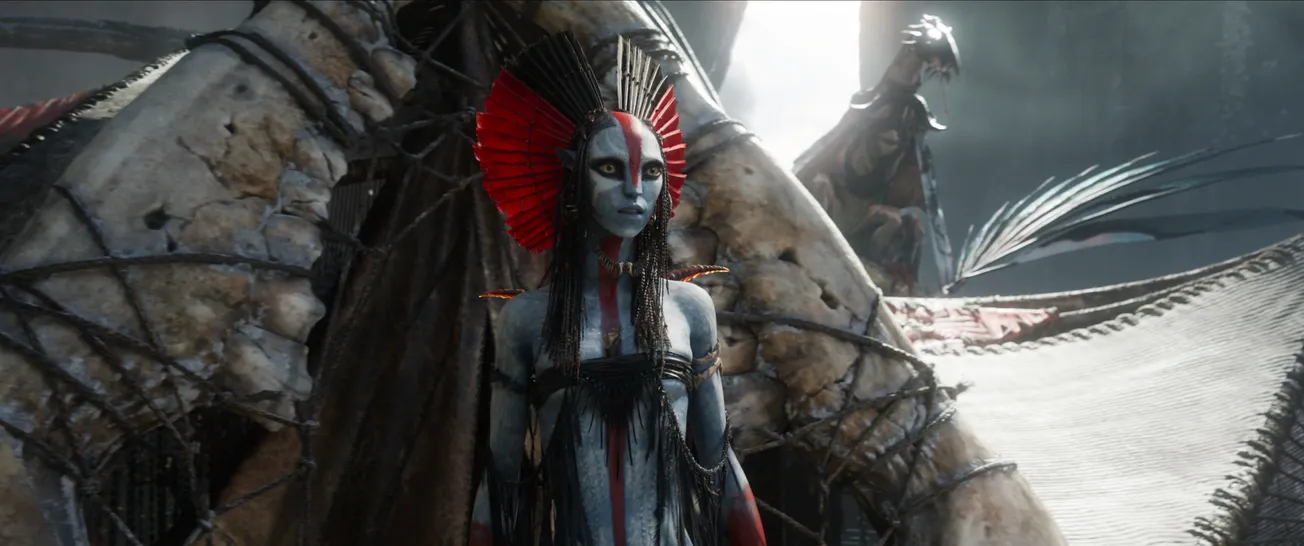
One of the strongest additions is Varang.
Varang Breaks the “Noble Na’vi” Illusion
Ever since the first Avatar, we’ve been led to believe that all Na’vi clans are spiritually aligned and morally grounded in the same way as the Omaticaya.
Varang is very different.
She is introduced as someone who watched her world burn and felt abandoned by Eywa. Instead of deepening her faith, she rises from the ashes in defiance of it.
That’s a bold choice.
Varang uses the Kuru to control and torture other Na’vi while also connecting to her mount, which, by the way, is a Nightwraith and not an ikran. At the same time, she refuses to connect to Eywa at sacred sites. You won’t find her at the trees the Na’vi hold holy.
She wants power. Not harmony.
I also couldn’t shake the feeling that she’s incredibly childish. We don’t know her exact age. Some fans place her in her mid-twenties. Others say she’s over 60. I lean toward the younger interpretation, mostly because we have a visual reference point in Mo’at, Neytiri’s mother, who returns in this film and clearly carries the weight of age. According to the wiki, Mo’at is somewhere between 65 and 75 during these events.
Regardless of the number, Varang reacts with excitement when Quaritch presents her with human weaponry. She almost lights up. And she rewards him for it.
That told me everything.
In her final scene, she connects with Kiri and flees after being intimidated. It’s not entirely clear what frightened her, but I suspect it was the prospect of reconnecting with Eywa, something she has actively rejected.
And she’s not done. She will return in the next film.
Lo’ak Finally Chooses Who He Is
Lo’ak’s journey might be my favorite part of the movie.
He goes from being alienated and looked down on by the Metkayina in The Way of Water to becoming the narrator of Fire and Ash and the character who tips the scales by convincing the Tulkun to join the fight against the RDA. That’s something even Toruk Makto never accomplished.
And yet, emotionally, he’s at his lowest.
Jake still blames him, at least partially, for Neteyam’s death. That tension lingers throughout most of the film.
There’s a moment where Lo’ak almost ends his life.
I genuinely didn’t expect the movie to go there.
He can’t do it. His friends don’t give him the space to spiral alone again. And Kiri immediately understands what he was about to do. When she says, “Stay in this life, brother,” that line stuck with me long after the credits rolled.
Fixing his mother’s bow. Searching for his Tulkun brother. Refusing to let his human features define him.
Lo’ak stops reacting to how others see him and finally chooses who he is.
This Is Neytiri’s Movie
If you ask me, this movie belongs to Neytiri.
She moves through distinct emotional states.
First, grief. The mourning paint. The silence. The half-presence.
Then injury. After the attack on the traders, she is shot and rendered unconscious. When she wakes up, she doesn’t retreat to the reef. She completes the journey back to the Omaticaya base instead, finishing what the family started.
Then comes rage.
“I hate them. I hate their pink little hands. I hate the insanity in their minds.”
It’s raw. It’s ugly. And it feels earned because Neytiri lost everything to humanity. first her sister, then her home, and now her first-born son.
But that’s not the final version of her.
When Jake surrenders himself to protect the Metkayina, Neytiri sets out alone to free him, now reunited with her father’s repaired bow, thanks to Lo’ak, and her husband's explosive arrows.
The turning point is the scene with Spider.
When she tells him, “I see you,” something shifts. There’s a new resolve there. Less reaction. More intention.
By the end, she feels transformed.
Spider Forces the Eywa Question
Spider’s transformation becomes the philosophical backbone of the film.
The RDA wants to study him to replicate whatever happened so humans can permanently live on Pandora and inevitably treat it the way they treated Earth.
That leads to one big question.
Is Eywa conscious? Is she watching?
We’ve seen through Kiri’s journey that Eywa appears almost person-like. She gazes at Kiri. She feels intentional.
But was Spider a mistake? Or was his transformation allowed?
Or maybe Eywa isn’t a conscious being in the traditional sense. Maybe she’s more like planetary infrastructure, the neural network that connects all life on Pandora. Not a goddess, but a system.
I think the truth is somewhere in the middle. Eywa might not start speaking to the Na’vi anytime soon, but I don’t think she’s passive either. She feels aware. Selective.
Some fans even suggest Eywa didn’t originate on Pandora but settled there.
That’s a theory worth its own deep dive.
The Ending Echoes Way of Water Too Closely
The Way of Water ended with a massive battle aboard a sinking ship.
Fire and Ash once again builds toward a huge water-based conflict between the Na’vi and the RDA. Once again, Eywa intervenes.
You could argue it’s intentional symmetry. A callback. A thematic mirror.
But it’s also repetition.
I enjoyed the movie. I really did. But if you ask me whether it stands fully on its own, I’d say it feels more like Part 2 of The Way of Water than a completely separate chapter.
And maybe that’s the point. James Cameron has said there’s a time jump between Avatar 3 and Avatar 4, suggesting the next pair will form a new arc together.
This one still lives heavily in the shadow of what came before.
Should You Watch Fire and Ash?
If you enjoyed the previous films, yes.
But go in knowing this is a sequel to a sequel.
Even the MCU films, as interconnected as they were, usually told contained stories. Fire and Ash mostly does, but it flirts with feeling like a continuation rather than a standalone experience.
That might be part of why fewer people showed up compared to the earlier films.
If you’ve seen it, I’d love to know what you thought.
Go back to the Avatar Movies page here.